Saturday, November 20, 2010

Article from Bhutan Observer (17 Oct 2010)

I found this article online, and thought it was interesting following the blog I just posted about food in Bhutan.  I have been spending a lot of time with a friend's little 2-year old son, and he eats very erratically.  His diet from what I can see is made up of candy and Coca-Cola, fried food, and chillies.  The food culture is changing slowly in Bhutan though it is still mainly within the upper and middle classes.  Just one of many aspects of a country in transition into the modern world.


=================================================================


So that we eat enough and healthy

BHUTAN OBSERVER. 17 October 2010.

The agriculture ministry is working on a food and nutrition security policy. It is a crucial policy that will have a far-reaching impact on the health of the population as well as the country. The policy is timely because we are now increasingly talking about poverty and poverty alleviation measures which comprise a host of economic activities.
Food and nutrition policy is particularly crucial for us because for a country vulnerable to untoward geo-economic situations, food and nutrition security also means national security.
Today, the concept of food and nutrition security has taken on many important dimensions. Availability of enough grains alone does not make a community food and nutrition secure. The people should be in a position to access the available food and utilise it in a nutritious and hygienic manner. After all these conditions are achieved, we must make sure that they are stable for all time to come. Then, we can claim that we are food and nutrition secure.
We are far from being food and nutrition secure. The production of food is beset with many formidable challenges. Productive agriculture land is limited and the yield from it is often compromised by difficult terrain, lack of irrigation water, destruction of crops by wild animals, and farm labour shortage, among others. These challenges are now compounded by laying the farmland fallow and development fast gobbling up productive land.
Access to food is often limited by difficult terrain, lack of roads, and market facilities. Utilisation of available food is also a big challenge for Bhutan. Our popular food culture is largely unhealthy. For instance, the average Bhutanese family’s diet largely comprises only rice with overcooked vegetables, often oily and spicy.
The government has already initiated projects like irrigation water schemes, farm mechanisation, and farmers’ cooperatives to meet these challenges. But it will take time, resources, and awareness.
Given widespread seasonal poverty and food shortages, particularly across rural backwaters, it is important that a robust food reserve strategy be put in place at the national, regional, and community level. In this context, we could learn from our forefather’s granary system during the troubled medieval time.
Because the concept of food and nutrition security is multi-dimensional, achieving it will need multi-sector efforts. Almost all the agencies, including the health and education ministries, must make specific effort towards achieving certain aspects of food and nutrition security. The policy makes many such issues clear.
Food and nutrition security policy is an idea whose time has come. Let’s take it forward.

Wednesday, November 17, 2010

Whine and Dine Bhutan

I haven't met a single traveller who's visited Bhutan who didn't rave about the beautiful Himalayan scenery and friendly, warm people.  They didn't however rave about the food.  In fact, it was quite the reverse.  Everyone told me to be prepared and bring little vacuum-sealed packets of sustenance if I didn't want to starve.  After all the packing was said and done (and let me tell you, winter packing is very challenging and space-consuming!), there was simply none left for food - granola bar, instant noodles, curry in a packet, or what-have-you.

So I have bravely set forth on my adventure without any food of any sort from home, determined to give things a shot.  First stop, Paro in Bhutan.  As I was walking around in this charming little town, I couldn't help but notice the well-lit, fully-stocked, horribly crammed, somewhat unsavoury-looking butcheries.  Bearing in mind that Bhutan doesn't really slaughter any meat within in the country (it being a staunch Buddhist kingdom), all the meat is typically imported from India.  Suffice to say, I will be mainly sticking to vegetables and eggs.  Contrary to popular belief, yak meat is hard to come by in Bhutan and is considered an expensive delicacy.  That is probably one meat I am okay with!

Desire
Meat Glorious Meat


Nonetheless, I did find some nice dishes - fried rice, bathu (a spicy clear soup with handmade noodles), and hot potato-filled samosas.  I also managed to put together a nice little meal with fresh produce from Bhutan - yoghurt, tomatoes from the South, cheese from central Bhutan, organically-grown fruit, and a little shot of Bhutan-made peach shnapps after dinner.  Life is good.

"Chaps" or bon appetit!

Hard cheese from Bumthang, honey and yoghurt, organic fruit, and a "French loaf"

Sunday, November 14, 2010

Adventuring in High Places

When you set out on your journey to Ithaca,
pray that the road is long,
full of adventure, full of knowledge.
The Lestrygonians and the Cyclops,
the angry Poseidon -- do not fear them:
You will never find such as these on your path,
if your thoughts remain lofty, if a fine
emotion touches your spirit and your body.
The Lestrygonians and the Cyclops,
the fierce Poseidon you will never encounter,
if you do not carry them within your soul,
if your soul does not set them up before you.


Constantine P. Cafavy


================================


There are so many women explorers who are inspiring - from Freya Stark to Alexandra David-Neel - who pushed the boundaries of society and dared to venture into realms unmapped.  While I could never hope to be as daring as they are (for they lost as much in their personal lives as they gained in adventure), I can try to step outside my comfort zone once in a while to try something new and different.  


I have arrived in Bhutan for what is hopefully the start of a journey of self-discovery.  


Wednesday, November 10, 2010

Stuff

"How much does your life weigh? Imagine for a second that you're carrying a backpack. I want you to pack it with all the stuff that you have in your life... you start with the little things. The shelves, the drawers, the knick-knacks, then you start adding larger stuff. Clothes, tabletop appliances, lamps, your TV... the backpack should be getting pretty heavy now. You go bigger. Your couch, your car, your home... I want you to stuff it all into that backpack."  Ryan Bingham, Up In The Air

And stuff it all into a backpack (and a duffel, and a suitcase) I did.  Boy was it crammed and heavy.  Yet it barely caused a dent among my considerable possessions!  I never felt quite so shallow and materialistic as I do now.  Though George Clooney's character Ryan Bingham was primarily talking about relationships weighing you down, the material goods are enough to slow you down and kill the proverbial shark ("Make no mistake, moving is living.").

Time will tell how well my 35kg of stuff will serve me.  Off to Bangkok we go - the start of my Himalayan adventures.


Friday, January 1, 2010

Bhutan - Into The Wild Blue


"I want to see the horizon and not see a single building standing tall"
Cowboy Take Me Away, Dixie Chicks

That was the tune in my head as I prepared for my departure to Bhutan, Land of the Thunder Dragon (also sometimes called the last Shangri-La or the Lost Kingdom). And upon my arrival, I was not disappointed.

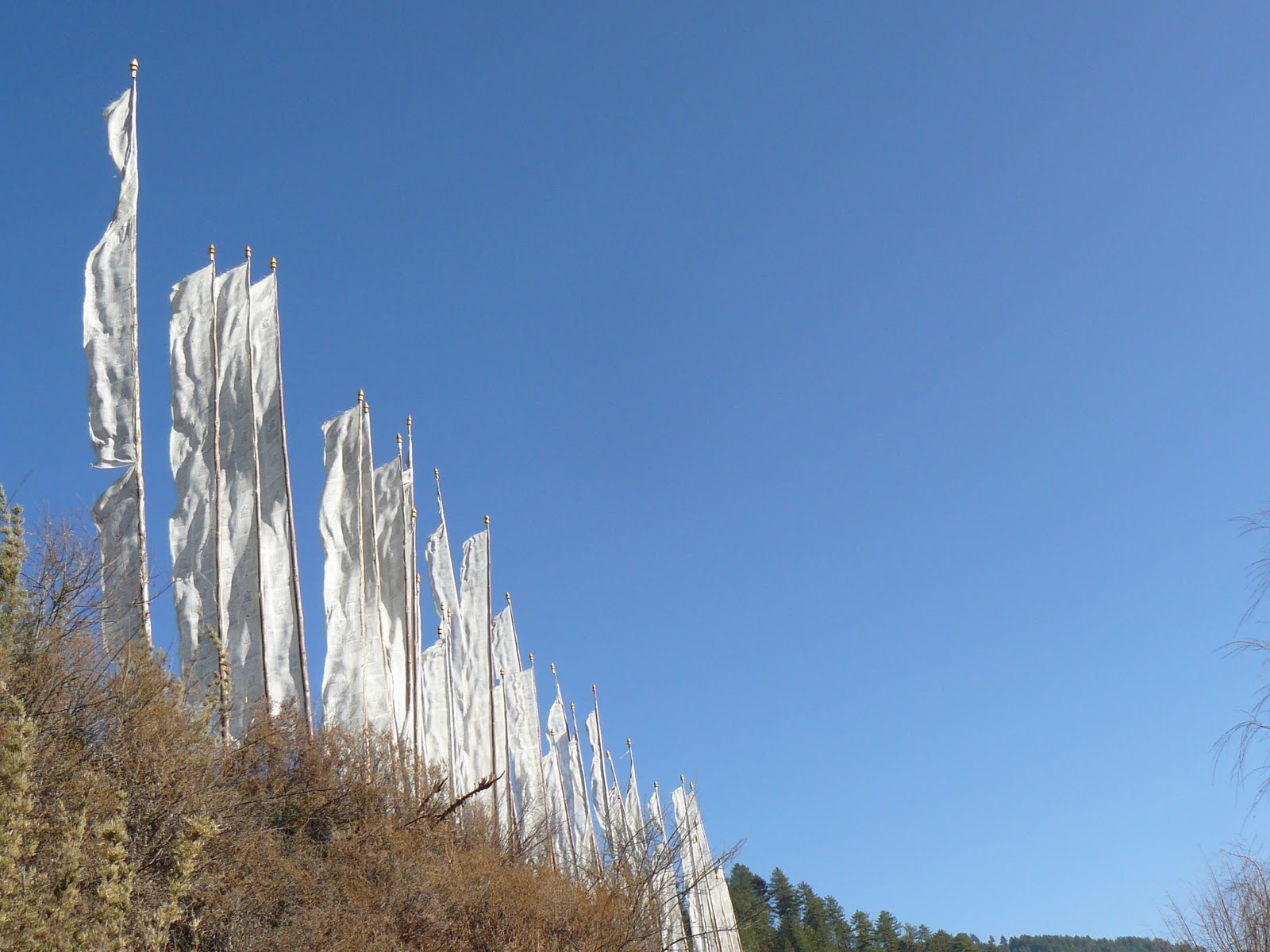
The horizon was filled with tall prayer flags fluttering in the wind, the silhouettes of blue pine forests, the mid-Himalayan mountain range, and low traditional Bhutanese houses. The air was crisp and clean, the sky an intense blue with bright sunshine. I stepped outside the small Paro airport with its single airstrip to meet my Bhutanese guide. My adventure had begun.

I first heard about Bhutan more than ten years ago in a South Asia politics class taught by Dr Walter Andersen, the then-Chief of the State Department's South Asia Division, Office of Analysis for Near East and South Asia. He raved about Bhutan, how pristine and beautiful it was, and how it was (in his opinion at that time) the most fascinating country in South Asia. Throughout the years thereafter, I'd met a handful of lucky people who had travelled to Bhutan and consistently told me the same things - pristine, beautiful, untouched by modernity.


I wanted to take a relaxing, year-end solo trip and a friend who had recently visited Bhutan put me in touch with a great little tour agency who arranged everything for me.

Bhutan is everything everyone said it would be, and struggling to keep it that way without compromising modernity and growth for its people. Deeply spiritual (indeed, superstitious) - the Bhutanese believe in lucky symbols, religious offerings on rock crevices and hillside roads, prayer flags in windy junctions to spread blessings, prayer wheels powered by natural springs from the mountains, and attached with bells that chime with each full turn. The spring water that spins the prayer wheel becomes naturally sanctified, and have founts where the thirsty traveller can drink from. These are everywhere - from the main highway that links Bhutan from east to west, as well as little villages you can only reach by foot.

Since the 1970s, Bhutan's former King (affectionately called "K4" by the Bhutanese) conceptualised a definition for quality of life beyond mere economic indicators like gross national product. He created the term "gross national happiness", which is the theoretical premise for Bhutan's national economic and development plan, where economic and spiritual development occur hand-in-hand. The four basic principles of GNH are:

- sustainable development
- preservation and promotion of cultural values
- conservation of the natural environment
- establishment of good governance

The last King has tried to put this theory to good effect in the economic planning and development of the country thus far, focusing efforts on developing hydro-electric power instead of energy-consuming and carbon-emitting industrial endeavours for example. There are also legal limitations put in place for felling trees and collecting firewood for the cold Himalayan winter nights to protect the beautiful blue pine and conifer forests of Bhutan. He also instituted the end of absolute monarchy - calling for democratic elections in 2008 to better prepare the Bhutanese for independent thinking.

In theory, it all sounds really good. Yet, the running of a country is never that straightforward. Alongside the wild and natural beauty of the valleys and mountains are the lives of some 600,000 Bhutanese citizens who are trying to cope with the 21st century - from the pressures of tourism to the transition to a democratic system.

There is a difficult balance to be maintained.

In the most recent 2009 National Day address, the current King of Bhutan (the oldest son of te previous King, who abdicated in 2008) placed a high emphasis on education by bestowing honourary medals on teachers from various parts of Bhutan. Education is important, yet it will change the economic landscape of Bhutan. As more Bhutanese children become literate, graduate with certificates from high school and university - subsistence farming will diminish at an even faster rate, exacerbating Bhutan's growing dependency on Indian imports of rice and wheat.

Bhutan's burgeoning urban's population within the next decade will also add pressure in the job market to expand and absorb these fresh graduates. At the moment, there doesn't seem to be a severe brain drain in Bhutan. Many Bhutanese are educated overseas (Australia, America, various parts of Europe) and return home to help grow and sustain their country's development according to the GNH principles. With increasing numbers of young graduates from agricultural families entering the job market, will there be enough job creation to keep them gainfully employed and happy? And who will keep growing the beloved chillies for Bhutanese ema datsi? Perhaps that burden will eventually fall fully on the shoulders of the Indian farmers just across the border.

Then there is the question of tourism: to open or not to open?

Bhutan's tourism policy is misunderstood by many (including myself). The tourist visa is not, in fact, restricted to a quota. Or not anymore anyway. What is prohibitive is the high cost of the minimum daily rate, which can range anywhere from USD200 - 240 depending on how many travel in a group. Add to this the relatively expensive Druk Air flight (USD850 for a 3 hour flight from Bangkok to Paro!), and Bhutan's tourism rates naturally filter out the backpackers and budget-trip seekers. Having said that, the daily minimum rate does include everything - a driver, a private car or van, a guide, all room and board, and entrance fees to various museums and monuments. The rate is also the same if you trek, accompanied by an entourage of baggage-carrying ponies, cooks, and general help to pitch the sleeping and dining (even toilet!) tents to greet you before you arrive at the designated resting point.

There is an on-going debate about how to increase tourism numbers in Bhutan, from the existing 20,000+ visitors a year to possibly 50,000. One of the solutions raised is the reduction of the daily rate, which many tour operators fear will lead to the "Nepalisation" of the lost Shangri-La. Instead of being the pristine and protected kingdom it now is - it will become just another stopover on the Himalayan backpacker trail.

While lowering the daily tourism rate seems like the easy and obvious solution - it doesn't really address other bottle-neck issues, namely logistics and transportation. In my informal chats with various guides and tour operators I met in bars in Thimphu and Paro, they mainly pointed the finger of blame at the limited number of flights by Druk Air. They could only sell as many tour packages as they could get seats. Even if Bhutan did attract 50,000 visitors - how would Druk Air and the little Paro airport cope?

Another discussion thread is the possible opening of a second airport in the middle of Bhutan, in Bumthang valley. This would really help build inroads for tourists seeking to venture into east Bhutan (no pun intended!), building up the tourism industry there without forcing tourists to endure a rough 3-day drive on narrow mountain switchbacks if they wanted a travel option that is off the usual Paro-Punakha-Bumthang track.

Personally, I don't mind paying the daily rate. I understand why it has to be that way, and does keep the country exclusive to the tourist who wants to be a visitor without being harassed by souvenir-sellers, or cat-called at by the locals. In fact, the one thing that did really strike me about Bhutan was how genuine, sincere and friendly everyone was. It sounds like the sort of stereotype one always says about Bhutan, but I guess there's no smoke without fire! People are curious but not gawking, always ready to smile and chat with you the moment you greet them, the children are coy but friendly, and best of all - nobody seems to want anything from you. Not money for taking photos of a little kid, not tips for good service, all of which can make you doubt the sincerity behind the gesture when you're travelling.

Finally, I think I only truly appreciated the beauty, serenity and simplicity of Bhutan after I left. It was a rude shock to fly into the gleaming and bustling new international airport in Bangkok, and be surrounded by duty-free shops that sell everything from exclusive hand-made Italian silk ties to high-end toiletry products - all of which seemed irrelevant in Bhutan.

My mind's eye still saw the fluttering prayer flags in the wind, heard the bells of the prayer wheels chiming, and I was happy.


Thursday, May 28, 2009

There Will Be Beauty

This article from the recent Vanity Fair (May 2009 issue) is written by A. A. Gill, currently a restaurant reviewer  with London's Sunday Times. It is in tribute to the beauty - indeed the relevance - of couture as inspiration, aspiration, and imagination.  Couture also protects cottage industries, fading traditions, almost-extinct skills and craftsmanship.  Enjoy...

----------------------------------------------------------------------------------

There Will Be Beauty

May 2009

It’s one of the great metaphysical mysteries of our equal-opportunity, post-feminist, oh-god-is-that-the-time lives—Why do men’s and women’s buttons do up differently? Or, rather, why do women wear their buttons the wrong way round? 

Well, a long time ago, in a land far away, it was decreed that men’s buttons should do up the easiest way for a right-handed chap on the inside of a shirt, but women’s should do up for the convenience of a right-handed girl on the outside of a shirt. It was assumed that all ladies would forever and always be dressed by their maids. (Who dressed the maid?) And the silent, servile, pursed mouth of a girl’s buttonhole still judges her a fingers-and-thumbs failure for having to do herself up. It is a ghost of couture, a reminder that once all clothes were bespoke, handmade.

This season’s couture shows bloomed like gardenias in the monastery of the new austerity. The collections blew kisses at our plastic-belt-tightening in these dressed-down, hard times. Couture laughed extravagantly at the bonfire of banking, the end of ostentatious consumption. It was, let’s be frank, a let-them-eat-cake moment, and we asked, Who on earth is going to wear this stuff? Who has the gall? Where is the ball? The galas, the dinners, the soirées? Where are these yards of elegant swank going to be appropriate? Where is all this expensive good taste going to look tasteful? These were the wrong questions. 

We should have asked: Do we really and truly want a world without couture? Are we willing to throw away what we have on top of what has already been lost? Is there no place for the exclusive and the beautiful? For the hysterically indulgent? And the superbly crafted? You have no idea how sensational a couture frock is until you’ve held one, or worn one, as Emily Blunt does with Victorian insouciance here. The skill in making them, the satisfaction of the stitching, the delicacy of the beading and the lacing, the softness and the stiffness, the fall and the rustle and the silhouette. It is the perfect detachable cosmetic surgery. 

The ateliers that fabricate these clothes are the repositories of centuries of prestidigious patience and acute, minute observation passed from thimbled, nimble fingertip to fingertip. Couture is a promise to the future from the past: There will be entrances and orchestras again, carriages and candelabra again, parties and seasons again. There will be glamour again. Throughout the history of civilization, doom, doldrums, depression, and disaster have descended to paint the town gray. But they will also recede, leaving little but a shudder. What is left, what abides, is beauty.

The button thing. Of course, it also means that a lady is more easily undressed by a right-handed man. Need you ask? It was probably all instigated by the French.


A. A. Gill is a V.F. contributing editor.


Wednesday, May 20, 2009

Apology to Women Over 40

Even though this "apology" is not actually spoken by Andy Rooney and is an e-rumour, I thought the sentiment was worth posting and gives me something to look forward to as I approach 40 :)

For anyone who's interested in the originator, it's Frank Kaiser - the writer of Suddenly Senior - http://www.suddenlysenior.com/praiseolderwomen.html


Presenting the e-rumour that has been flying around the internet.
--------------------------------------------------------------------------------
From 60 Minutes Correspondent Andy Rooney (CBS)...

As I grow in age, I value women over 40 most of all. Here are just a few reasons why:


A woman over 40 will never wake you in the middle of the night and ask, "What are you thinking?" She doesn't care what you think. If a woman over 40 doesn't want to watch the game, she doesn't sit around whining about it. She does something she wants to do, and it's usually more interesting.

Women over 40 are dignified. They seldom have a screaming match with you at the opera or in the middle of an expensive restaurant. Of course, if you deserve it, they won't hesitate to shoot you if they think they can get away with it.

Older women are generous with praise, often undeserved. They know what it's like to be unappreciated. Women get psychic as they age. You never have to confess your sins to a woman over 40. Once you get past a wrinkle or two, a woman over 40 is far sexier than her younger counterpart.

Older women are forthright and honest. They'll tell you right off if you are a jerk if you are acting like one. You don't ever have to wonder where you stand with her. Yes, we praise women over 40 for a multitude of reasons. Unfortunately, it's not reciprocal.

For every stunning, smart, well-coiffed, hot woman over 40, there is a bald, paunchy relic in yellow pants making a fool of himself with some 22-year old waitress. Ladies, I apologize.

For all those men who say, "Why buy the cow when you can get the milk for free?", here's an update for you. Nowadays 80% of women are against marriage. Why? Because women realize it's not worth buying an entire pig just to get a little sausage!

Thursday, April 30, 2009

Agape

On the 19th of April 2009, Prince Philip - the Duke of Edinburgh and consort to Queen Elizabeth - made headlines around the world as the longest-serving royal consort. 57 years and still going strong.

That in itself was an interesting factoid, but what caught my attention was Queen Elizabeth's speech made during their golden anniversary celebration ending with simple, touching words:

"He is someone who doesn't take easily to compliments, but he has, quite simply, been my strength and stay for all these years..."

In this fast-paced and increasingly borderless world that we live in, our choices in life keep expanding and it often becomes confusing, even difficult, to develop and maintain a love such as theirs. Couples form, walk together for a little while, and eventually part ways for a variety of reasons.

Yet I take heart when I hear news of long-lasting relationships. They inspire and spur us to seek this ideal of love that provides a shelter from the storm, a respite from hectic routine, and a peaceful sanctuary of retreat.


In hac spe vivo.

Wednesday, January 14, 2009

RAWdance at the Singapore Fringe Festival

Many years ago, my good friend Michelle invited me to a modern dance performance by the Alvin Ailey American Dance Company. It was visually impactful, but it didn't leave much of an impression on me other than "Huh?". Since then, I've always demurred when asked to come along for modern dance performances. It always seemed too abstract and distant from my own world.

Last night, a friend of mine dragged me to a modern dance performance citing that his friend from San Francisco was performing and I just had to come and give my support. I agreed, and this time my eyes were opened to the possibilities of modern dance.

The dance company we saw was a young company called RAWdance - helmed by Ryan and Wendy, two (in my opinion) really talented and self-effacing artistic directors. The 2009 Fringe Festival explored themes of family - broken families, family tensions, and so on. And RAWdance debuted "Fallout" - a scrutiny of 1950s nuclear family structure going through cultural changes due to pressures from within and externally.


Many things were great about this performance, not least the intimate size of the Theatre Studio at the Esplanade - which lent itself very well to a modern dance performance like "Fallout".

What struck me first was how similar to a play without words the performance was. It started out on a dark note: a man attempts to pour himself a glass of water (or perhaps it's alcohol) that is resting on the belly of the woman as if she is a table. The growing tension - a mix of passion, resentment, the struggle between the sexes - was encapsulated in the almost-violent push and pull of the opening dancers' duet.

Now I realise how much more impactful a dance performance can be when you're up close enough to see the expressions on the faces of the dancers, and how much meaning can be packed into a gesture of the hand, a twist of the torso, and the arch of a foot.

The piece was painful, tackling dark themes about family life behind closed doors. During the post-performance talk, someone asked the question if Asians in the audience could relate to what might seem a very American theme - struggles of the nuclear family in the 50s. At times, it was also very humourous - with a scene reminiscent of the Stepford Wives fencing with kitchen utensils over who's the better housewife played out against a sugary-sweet song from the 50s. I particularly liked the creative way the women were "transformed" into large weapons (Uzis and anti-aircraft missile launchers) through which families hurt each other.

Some in the audience felt that they couldn't relate because Singapore has large extended families rather than nuclear families, and certain themes of family struggle was over-dramatised. In fact, I believe quite the opposite. All the tension between the sexes, the struggle to be free yet being held down by the people who supposedly care about you - this is possibly more true in an Asian context than in America where people are more free to express themselves. The internal nature of the family tension and discontent couldn't have been better expressed in "Fallout" - effectively a silent, reflective struggle expressed through the medium of dance.

In Asia, the tension still simmers beneath the surface because no one ever talks about it even if they feel it. There is self-censorship to keep the peace. Parents who are married for decades don't really communicate or speak to each other. They want different things from each other, but neither know how to express it with the tenderness of truly knowing each other. Certain topics are completely ignored or glossed over, while deep inside - emotions are boiling over.

Complex issues about parent-child tension also exist in most Singaporean families. I'll pick the easiest example: The son wants to be a musician but is forced by his parents to be a lawyer instead. The oldest child wants to leave the family nest and become independent, but is held back due to family obligations.

While none of this is deliberately spelt out and is obviously my own interpretation of the dance, the main elements are very strongly expressed in the dancer's increasingly desperate and frenzied attempt to dash through the other dancers who kept holding him back, throwing him down, stifling him but with a mix of tenderness and reproach.

It finally ended on a slightly upbeat note. The "family" watches on as a single member breaks off into a conventional white picket fence life and truly struggles with it. They slowly gather around her to give support in a way that seems slightly menacing, only to extend a flower of sympathy. Whether she accepts it is open-ended.

I never knew that dance could say so much and be so open to interpretation. And now that I have seen what I've seen - I will definitely be back to see more dance performances in the future.

Thank you Michelle, for starting me out. And thank you RAWdance, for convincing me :)

Check out RAWdance at: http://www.rawdance.org

Saturday, December 6, 2008

Laos - the not-so-lost kingdom

Laos - they used to have a million elephants, and now they have two thousand - mostly in elephant camps and in the logging industry, controlled and trained by mahouts (elephant trainers). Though still considered mostly an isolated country by Southeast Asia standards, change has definitely come to Laos.

Named "Land of a Million Elephants and the White Parasol" by Fa Ngum, a Cambodia-backed Lao prince who married a Khmer princess and ascended the throne as a result. The tradition seems to have continued into the 20th century, where the last king Sisavong also married a Khmer princess (granted she was one of 15 wives he had). The culture and food of Laos has some similarity to its neighbours Cambodia, Vietnam and Thailand - yet it has managed to avoid the rapid development and transformation that its neighbours have undergone.

Laos is considered "off the beaten track". Not the easiest of countries to travel to, literally four international airlines fly in and out of the capital Vientiane (China Eastern, Vietnam Air, Air Asia and Thai Airways).

Despite that, it's obvious that lots of people have visited Laos, liked it so much that they've decided to stay and try to transform it into a granola-crunchy utopia. Every imaginable NGO and development institution resides in Laos - from the ADB, to the UNV. Even the Mekong River Commission has its headquarters right on the banks of the Mekong (of course) outside the Vientiane city centre.

Apart from these larger organisations, the granola-crunchiness also extends downwards to small Laotian enterprises (mainly the ones catering to the burgeoning tourist industry). Many local tour agencies offer "eco-tourist" options - from "fair" trekking where a percentage of the earnings from the guide will be paid to the villages tourists walk through, sustainable community development through building of schools and skills training, and support of cottage industries and traditional crafts. Even my little US$15/night hotel stuck stickers in the bathroom, warning me of global warming and environmental damage - so please turn off my lights and re-use my towels!

How did Laos - neighbours to Cambodia, Thailand and Vietnam - develop in such a tranquil manner? So many foreigners seemed to have been charmed and lulled by the atmosphere of Laos, fallen in love and been determined to preserve it ever since.

Some of the institutions in Vientiane which I found interesting:

TRUE COLOUR - a women's handicrafts cooperative started up by a Lao woman and run on funding from the Japanese government and generous individuals. The store sells completed products from the Houey Hong Vocational Training Centre for Women. Laotian village women in particular are trained to create higher quality products while keeping to the traditional weaves of their culture. The money raised goes directly to the women and the cooperative. And tourists can even take lessons on how to dye cloth or weave.

http://houeyhongcentre.com/about.php

MAKPHET - one of my favourite restaurants visited during my stay in Laos, it's run by Friends International which takes in street children and prepares them for reintegration into society and vocational training in the culinary arts or the running of a restaurant. The children learn to wait and serve, they also make lovely little handicraft from recycled material in the small gift shop on premise. And if you're worried about the quality of the food, don't be. The food is simply marvellous. Not exactly Laos, not exactly Western - they've managed to come up with some unique and delicious recipes. Their desserts are also great.


CAROL CASSIDY - A vivacious, extroverted American - she moved to Laos some years ago, setting up a workshop of dyers, weavers, and even a mulberry farm which produces its own silk. Her designs are beautiful, often integrating traditional patterns with architectural designs, creating something that is quite stunning though very pricey. Her designs are sold at the MoMa, and she has visited Washington DC's Textile Museum as a guest speaker.

http://www.laotextiles.com/

Luang Prabang is even more a hub of granola-crunchiness than Vientiane. It has that whiff of backpacker about it, but there is an air of affluence about it. It's the sort of place where the backpackers are young well-to-do Europeans doing their round-the-world-on-a-shoestring would hang out, smoke ganja and go jungle trekking. One of my favourite places was a little cafe called Saffron, where they make espressos from coffee beans grown locally in Laos. They've even got "fair trade coffee" tee-shirts for sale.

I'm sure all this must sound quite alarming to tourists who had visited Laos in the past and not experienced all this commercialism (albeit under the guise of sustainability). It was equally alarming for me when I first visited Yangshuo in the south of China, and was confronted with a shrivelled old lady asking in English "Peanuts? Peanuts?" and banana pancakes on every breakfast menu in the area!

No matter what, there seems to be a sense of willingness for the Laotians to embrace and adopt the middle-class backpacker's idea of a Southeast Asian Shangri-La. Yet, I can't help but wonder how one tells what the real Laos and what this made-up, tourist version of Laos is.

At the end of the day, I like Laos. There are places within (a little further even off the beaten track) where you can still see glimpses of everyday life without the influence of the socially conscious foreigner. It just takes a bit more digging beneath the surface, a little more effort.


Thursday, October 30, 2008

You can't make a silk purse out of a peasant's bag

I lay no claim to the following article, wittily and wickedly written by The Times regular columnist Caitlin Moran. But it's too funny to ignore. Especially the Guernica in ponyskin comment.

I promise to lay aside my Chanel bag-owning aspirations during this time of financial crisis. I am not, I repeat NOT, deranged and unpleasant. (oh my god! is that the latest denim blue
Chloé...). Just kidding.

============================================

http://www.timesonline.co.uk/tol/comment/columnists/caitlin_moran/article5008574.ece

From
October 27, 2008

You can't make a silk purse out of a peasant's bag

The handbag I would like most is a big, hollowed-out potato with handles; in times of crisis I could bake and eat it

Should I buy a £600 handbag? “What are you talking about?” many of you might ask. “What on Earth are you saying? Do you know that there's a recession on? Do you know that old people are having to throw their trusted companion-cat, Mr Whiskles, on the fire, just to keep warm? Didn't you see the It's Fun To Eat Worms! supplement in The Guardian? Should you buy a £600 handbag? What kind of obscene question is that? You're deranged and unpleasant.”

To which I say: “I know all that. I know. But Grazia magazine doesn't. Tell Grazia. It's Grazia that told me I should have a £600 handbag, that it would be a style investment. Tell Grazia!”

Of course, it isn't just Grazia that's making me think that I need a £600 handbag. I am not a simpleton. I am not so easily led. It's the Woman supplement of The Observer, too. Before I began reading these periodicals, my stance on “investment handbags” was that if I were going to make a £600 investment, it would probably be in post office bonds, not something that, by and large, lives on the floor in pubs, or which I sometimes use to carry 5lb of potatoes. But in the past year I've begun reading women's fashion magazines and am aware that I am in a handbag minority. Normal women, says Grazia, do not buy one handbag every five years for £45 from Topshop; normal women have dozens of handbags: small ones, potato-less ones, £600 investment ones such as a Mulberry tote. With mounting alarm, I learnt that having a £600 handbag is like having a crush on The Joker in Batman. It is an irreducible fact of being a woman.

The October edition of Observer Woman, however, brought matters to a head. Lorraine Candy, Elle's editor-in-chief, tried to go a week with just high street gear. On the Wednesday she writes: “I've failed. Today, I know that I cannot brave that front row with its cool bags and sexy ankle boots without the one thing that makes my outfit work: my new Chloé bag. I feel ashamed.”

I had a flush of horror: no one has ever passed judgment on my cheap handbag to my face. But then, this is a reserved country. I don't know how they would react to my £45 handbag somewhere more demonstrative - Portugal, say, or Texas. They might leap on to their chairs screaming “MAH GAHD!”, trying to hit my cheap handbag with a broom, as if it were vermin.

That night I made a decision. One of the modern wisdoms of womanhood is that eBay has fake designer handbags that you can't tell from the real thing. But despite typing in “great fake £600 handbags for £100” into the “Search” field, nothing came up. In despair I was driven to look for £600 handbags for £600. Vuitton, Prada, Chloé; £300, £467, £582. God, they were horrible. Like Guernica, in ponyskin. I tried to find one I liked. I really did. Tanned, tasselled and oddly shapeless, many resembled Tom Jones's knackers, with handles. Others were covered in straps, buckles and brasses, like some S&M horse. There was a whole shelf of leather clutches with gigantic gold clasps that looked a bit as if someone melted Grace Jones in 1988, leaving behind only her blouson leather jacket and huge earrings.

On page 14 of my Search Results I finally saw one I liked, by Marc Jacobs. It was bright, acid-house yellow, with a picture of Debbie Harry. But my joy in finding a £600 bag I liked was mitigated when, on closer inspection, it proved to be a canvas tote, for £17; basically, the only designer item I was attracted to was a Marc Jacobs carrier bag. I was thrown into existential despair.

I am not wholly unfashionable. I have learnt some things about style over the years. A bright-yellow shoe is surprisingly versatile, patterned tights are never a good idea. And if - through chaos, fate and backed-up laundry - you end up in an outfit of alarming randomness (socks, Crocs, tuxedo jacket and tricorn hat), you just look people in the eye and say, with crocodilian self-assurance: “I don't like to be too matchy-matchy.” But if I cannot connect with the finer things in life, if £600 handbags fundamentally revolt me, this must prove that I am a peasant. If I really were of noble blood, left by mistake on my parents' council house doorstep (as I still, albeit fadingly, believe), I would, surely, have an affinity with these things. It would be like the princess and the pea. I'd probably get a rash if I used a handbag worth less than £500. Every time my eye is unstoppably drawn to some bright red thing in “pleather” for £45, it's further confirmation that I am resolutely of the underclass.

If I'm honest, the handbag I would probably like most is a big, hollowed-out potato with handles on it. Then, in times of crisis, I could bake and eat the handbag and survive the winter. That is the way of my people. And yet, despite all this, my handbag-psychology denial rumbled on. Yes, those £600 handbags might be visually unappealing, I thought to myself. But maybe if you touch them, they have some manner of £600 magic that makes it all worthwhile.

“They will all be made of butter-soft leather,” I told myself, not really knowing what that meant. “You can always tell the difference close up. People who come near me and feel the bag will know my true nature.” I went to Liberty and walked around, touching the handbags, waiting for the enchantment to overwhelm me. They all just felt like handbags. I did, however, see a silvery purse that I liked. For £225.

“I am classy after all!” I thought, running to the till, incurring a £40 overdraft fine and a rumbling schism in my marriage. “Maybe I have a secret uncle who's an earl! True breeding will out! Finally I crave expensive designer items! I'm normal! Thank you, Grazia!”

Five days later the silver purse was pickpocketed on Gower Street. It turns out that thieves read Grazia, too. They can spot expensive accessories from 500 yards away. It also turns out that husbands do not read Grazia, and no matter how magnificent or loving they may be, they can't help themselves from sporadically saying “£225! For a purse!”, as if you've just deflated the Moon and put it in the bin. Again.

I've gone back to my £17 purse and £45 handbag. I know my place in the handbag class system. My name is Caitlin Moran, and I am an accessories peasant.

Thursday, October 2, 2008

Singapore Biennale 2008

I haven't an artistic bone in my body.  I can't paint (except the occasional piece of furniture), and I can't draw (except for a fairly decent stick figure).  Therefore, I am always very inspired and moved by artists who have a vision and execute it.

The Singapore Biennale 2008 is the second time that Singapore has hosted an art biennale.  I chatted with several overseas clients who managed to visit it on their trip to Singapore, and they consistently mentioned that the biennale's standard was one of the best they'd seen.  Therefore, my curiosity was piqued and I went to check it out myself.

It was a mixture of good and average, with some exhibitions leaving me quite breathless.  The venue was also interesting - old Supreme Court in SIngapore.

Here are the highlights of what I liked:

"Singapore 2008" by Wit Pimkanchanapong from Thailand
A life-sized Google Earth map installation of Singapore where visitors to the exhibition could interact with post-it notes, simulating the online tagging of places (right down to specific addresses) on Google Earth.  I left a little post-it right over my house :)


"Tropicana 2008" by E Chen from Taiwan
An elaborate woollen set, complete with mailbox, scooter, chairs, tables and a little garden - a motor quietly and slowly unravels the entire set until it becomes a pile of yarn.  Ashes to ashes, dust to dust.  The transcience of objects - right down to art.

"Little Guilin: (Bukit Batok Town Park) Singapore 2008" by Gary Carsley from Australia
This one is a nice little surprise.  The artist took IKEA furniture (cheap at best) and transformed the interior of the closet and drawers into an elaborate, precious work of art.  From a photo, he painstakingly re-creates the image of Little Guilin with layers and chip of veneer.  His style, called Draguerreotype, references the process of dageurreotyping but with the idea of "drag" or dressing up.


"Blackfield 2008" by Zadok Ben-David from Israel
A two-dimensional sculpture - the viewer's perspective is challenged depending on the angle the installation is viewed.  Essentially an intricate field of tiny metal flowers and plants, it is a colourful and happy garden from one side.  On the other side, it is a charred and depressing "blackfield".  


And finally, the highlight for me was a mesmerising collection of photographs from Dutch photographer Desiree Dolron.  Her photography (which I later discovered after I saw her work at the Singapore Biennale 2008) is haunting and introspective.

This is what she displayed - a beautiful selection of photographic art which references Vermeer and the other Dutch masters who did beautiful portraits with the play of light.


Her work is so gorgeous it's worth checking out: http://www.desireedolron.com/

And in case you're too lazy but somehow managed to stumble upon *my* blog - then here's a few she took in Havana, Cuba - very romantic and melancholy.


I do look forward to the return of the Singapore Biennale in 2010.

Monday, September 29, 2008

Bright Lights and Fast Cars

I have never been interested in cars, which probably explains why I like and drive the car that I drive. Therefore when Singapore announced that it would host a Formula One Singapore Grand Prix, it made no impact on me. All I knew about Formula One then was that Lewis Hamilton is a hot British driver, and Kimi Raikkonen has mesmerising eyes (so my colleague tells me).

Singapore was planning to hold Southeast Asia's first street race
à la Monaco - whose Formula One street race is dubbed "the crown jewel of Formula One". Everyone (even a non-enthusiast like myself) knows that Monaco's Formula One is famed for its celebrity-studded parties, glitz and glamour. So how could Singapore, known for its staid nightlife, efficiency and cleanliness, hope to compete against that?

For one, we decided to hold it at night and make Formula One history.

The well-oiled machinery that is Singapore, and the efficiency of the Singapore organisers were definitely a boon in this case. As the weeks drew increasingly closer to the dates of 26 - 28 September, Singapore began to prepare itself for this event on a scale that was unlike any other event ever hosted on our tiny island-state. Massive roadworks and upgrading projects were undertaken with an aggressive timeline. In the final days, the lighting systems were tested and it was exciting to think that the very same road my humble Honda was driving on would be the self-same race track of the souped-up Ferraris, Renaults and Mercedes.

Nearing the race dates, all anyone could talk about was this or that F1 party or event. Many lifestyle companies were gearing up for corporate events on a scale and budget never heard of before in Singapore. Various celebrity performers (Chicane and Emma Shapplin to name a few) were flying in for special appearances and performances. I saw Jackie Chan arrive at The Fullerton Hotel on the eve of the Formula One races. We were beginning to feel like a cool and fun place!

On the first evening of the races, I walked around the Financial District where part of the race would pass through. I could hardly believe my senses. The excitement in the air was palpable, and the atmosphere was simply buzzing. People milled about, and everyone seemed eager with anticipation for the practice sessions and a chance to hear the engine roaring as the race cars whizzed by in a lightning speed blur.

The three days passed quickly and every single day, there was a sense of festivity. Every evening, bars and clubs were filled with a boisterous crowd of locals, expatriates and international visitors. Every day, guests would go out and shop or visit the local sights in Singapore. Things were bustling in Singapore, recession looming or no.

Someone asked me, how does this benefit the heartlander*? Afterall, the heartlander is not going to shell out a few hundred dollars for an F1 walk-about ticket to enjoy the hubbub of Formula One. True as this may be, the coming of Formula One to the shores of Singapore has much wider repercussions than whether the average Singaporean suffers from a few days of traffic jam.

In the midst of international financial turmoil and economic crisis, we managed to pull off an event of international standing that felt both glitzy and prestigious. We attracted a record number of visitors who came to Singapore and spent money in Singapore. More importantly, they enjoyed themselves. The initial feedback in the news indicated a general sense of enthusiasm and anticipation from the drivers about the Singapore Grand Prix. Other commentators have dubbed Singapore as undoubtedly a strong competitor of the Monaco street race. That's quite an endorsement! I believe we have a ways to go to challenge Monaco, but Monaco does set the standard for us to aspire to.

To date, Singapore has played host to many high-profile events, including the 2006 IMF/World Bank annual meetings as well as the 117th International Olympic Committee Session. While these prestigious events gave Singapore some degree of visibility on the world map, all of these fade under the bright lights of the Singapore Formula One Grand Prix.

Although a heartlander may not be able to afford tickets to the Formula One, the race still changes our lives in subtle ways. Watching the race coverage on television, the helicopters showed Singapore from the air - a gorgeous, glittering city skyline as I've never seen before in my entire 23 years living in Singapore.

Apart from invoking a sense of patriotism and national pride that the orchid motif batik shirt "national dress" never quite achieved, the race has finally put Singapore on the international map of cool places. The trickle-down effect of the money spent on tourism and the lavish corporate events have also benefited the heartlanders directly. It also gives Singapore and Singaporeans the international exposure that could be the key to pushing us - as a society - to the next level. No other event in Singapore has come close to this.

I don't know about anyone else, but I am definitely looking forward to Singapore Grand Prix 2009, when I'm sure the organisers will do an even bigger, better race!

*Heartlander: Defined as a Singaporean who is generally poorer, less educated, either working class or lower-middle-income, speaks Singlish, lives in government housing estates, and has a local (rather than global) perspective on political, economic and cultural issues.

Monday, September 15, 2008

Malaysia Boleh!

I recently went up to Kuala Lumpur - otherwise known as KL - for work, and decided to extend my stay over the weekend to visit my aunt & uncle - who have lived and worked in Malaysia for more than 20 years.

My visits with them are always fun, with my uncle and aunt plying me with more food than humanly possible. They enjoy spoiling me, and invariably take me to one of my favourite Chinese restaurants for "
sang ha min" (ie, freshwater prawn noodles - GIANT prawns wok-fried in a fragrant soya sauce stock then poured over crispy egg noodles - heaven in your mouth with some nice chilli padi). Needless to say, I always leave KL several kilograms heavier - belly full of food, bags filled with new clothing & shoes.


During my many visits, my cousin always tries to convince me that I should find a job in KL and move there. He is Singaporean, mind you - did his 2.5 years of National Service duty to the nation, albeit as a Malaysian Permanent Resident. So what is it about Malaysia that has so greatly appealed to my aunt and uncle's family, all born and raised in Singapore, yet who have mostly (save one cousin) decided to make Malaysia their permanent place of residence?

I have visited Malaysia many times in my life but my trips are never longer than 3 days and typically focused on food and shopping (or is it shopping and food?). My experience of Malaysia is superficial and limited, to say the least, and I never once questioned the idea that Singapore is a far superior place to live in.

On this trip, it suddenly struck me what the tourism board tagline meant:
Malaysia, Truly Asia. In some ways, it is truly Southeast Asia. With its multi-ethnic society not unlike Singapore's, each race seemed to be more actively vocal than in Singapore. Going around KL, one can hear a polyglot of languages and Chinese dialects - suppressed by the Singapore government in favour of standardised Mandarin Chinese. With its dirty streets, over-stocked and spicy-smelling grocery store shelves of everything under the sun, unhealthily delicious food, kampung-esque city planning - Malaysia is a great way to experience Southeast Asia in all its unkempt glory.

On the Malaysia vs Singapore issue, I could sum up the differences in three areas: food, cost of living, and politics.

I shall start with my favourite topic - indeed the favourite topic of the Chinese! -
food. In terms of variety, flavour and authenticity of street food and Chinese "zi cha" (home-cooked) food - Singapore gravely loses out to Malaysia. Where the modern denizens of Singapore have become health-consciousness and eliminated many traditional ingredients in Chinese cooking, the Malaysian Chinese still retain the old ways - pork lard, extra salt, dash of ajinomoto (aka monosodium glutamate), deep-fried this and that in animal fat. This leads to an extraodinarily rich menu - probably the sort that brings on gout if one is not careful.

My cousin took me out for after-hours, post-drinking street food from a mobile steamboat stall. This type of street fare, called "
lokeloke" (ie, dipping in Cantonese), is a real favourite among the club-goers. Selecting from choice delicacies like skewered cockles, baby octopus, cuttlefish tentacles and pigs' umbilical chord (apparently a treat that is hard-to-find) - one dips the whole lot in boiling water then douses it with salty, spicy chilli sauce to eat while still steaming.


My uncle also brought me to one of his favourite family-run hawker centres where he and his family eat on a regular basis. For dinner, he ordered:

- whole pumpkin with seafood delicacies like fish maw, scallops, sea cucumber, and tender shrimp cooked in a light, sticky broth
- pan-fried chicken then stewed in a claypot with dark and sweet soya sauce
- pork ribs marinated in Guinness Stout and stewed till tender
- a whole steamed garoupa
- fried
kangkong (water spinach) with sambal belacan (pounded chilli mixed with pungent shrimp paste)
- large, deep-fried tofu squares (still white and soft on the inside) topped with a delicious blend of minced pork and finely chopped preserved radish (
chai por)
- giant shrimp covered with mashed salted egg yolk and deep fried to a crisp

All this was served with a few bowls of rice, a wok-fried rice noodle dish and "
gat zai xi muoi" (lime juice with preserved sour plum) to wash it all down. This feast fit for a king fed eight adults and cost Malaysian Ringgit 280 or S$120+. This is completely unheard of in Singapore, especially for the quality and size of dishes that were ordered. This meal would have easily cost S$400 in Singapore, and the taste would probably have been toned down considerably. As my aunt puts it, Singaporeans become birds when they arrive in Malaysia. All you hear them say is "cheep! cheep!" (translation: cheap, as in highly affordable). It must get quite tiresome for the Malaysians after a while......

Therefore
cost of living is another factor to consider. My cousin always tells me how much more affordable it is to buy a car, a house, and other material possessions in Malaysia. Granted that wages are considerably lower in Malaysia than in Singapore, but the cost of living is still less than in Singapore.

The only worry I would have about ostentatiously gathering too many material goods is that crime in KL is rapidly rising and one can easily become a middle-income target for petty thieves and organised burglars. Such behaviour also serves to perpetuate the myth that all ethnic Chinese in Malaysia don't require any governmental support because they can "take care of themselves". The truth is, the gap between the haves and the have-nots still remain quite wide, though the ethnicity at the bottom of the economic rung in Malaysia is undoubtedly the Indians.

Finally, one of the most interesting observations to arise from my recent visit to KL is
politics. Singaporeans are probably one of the most depoliticised societies in the world. With no real viable government opposition movement and generally little popular interest in local politics - Singaporeans probably know more about the on-going American election campaigns than what goes on inside Singapore.

For the Malaysians, the recent success of Anwar Ibrahim's re-election to the Parliament in the August has been on everyone's lips. He has since publicly announced his bid to oust the current government by winning over 30 more seats from the ruling coalition - the Barisan Nasional - by Tuesday, 16 September. As of Monday (15 September), Mr Ibrahim already told rally supporters that he had the numbers to defeat the government.

In anticipation of this date, my aunt has rushed off to the supermarket to stock up on some food in case Prime Minister Badawi takes drastic action. Well, he did already - by shipping off 50 of Malaysia's lawmakers to Taiwan on a "study trip" - taking them as far away as possible from Anwar Ibrahim's reach. Then the infamous Internal Security Act (ISA) was put to use over the weekend, on a Chinese newspaper journalist (freed shortly after) as well as an opposition lawmaker and anti-government blogger (yet to be released). This then prompted the resignation of the Law Minister Zaid Ibrahim. Little wonder that KL folks can only talk about politics at the moment.

Singaporeans are very fortunate because we have a stable government that has, thus far, looked after our needs if in a paternalistic fashion. On the negative side, we don't have the standard checks and balances to prevent the government from abuse of power. On the positive side, we haven't had any real need to, to date. The struggle for change and a perceived greater good has been replaced by a more self-centred struggle for economic advancement and wealth accumulation. It's the norm for developed nations, but sometimes seems to leave us a little soul-less.

Arriving back into Singapore at dusk - I can't help but observe the clean tidy streets, the gleaming condominiums, and wide sidewalks where Singaporeans are safely going about their business on a Sunday evening. I like not worrying about parking my car outside my gated compound. I like not wondering if I'll be mugged, or fined for "speeding" by a corrupt policeman who'll then take a bribe to release me. Singaporeans have paid the price for this social contract with the government.

I wonder how Malaysians feel when they visit Singapore. Do they think we are a bunch of spoilt, well-to-do neighbours? Do they feel that we are lucky yet ungrateful? Are they star-struck and taken in by the apparent wealth and comfortable standard of living?

Whatever it is, I know that this trip has only served to whet my appetite to learn more about my neighbouring country - a wilder, more liberal (due to lax & corrupt officials rather than lack of legislation) version of Singapore. A version Singapore could have ostensibly evolved into given a different political and economic trajectory.